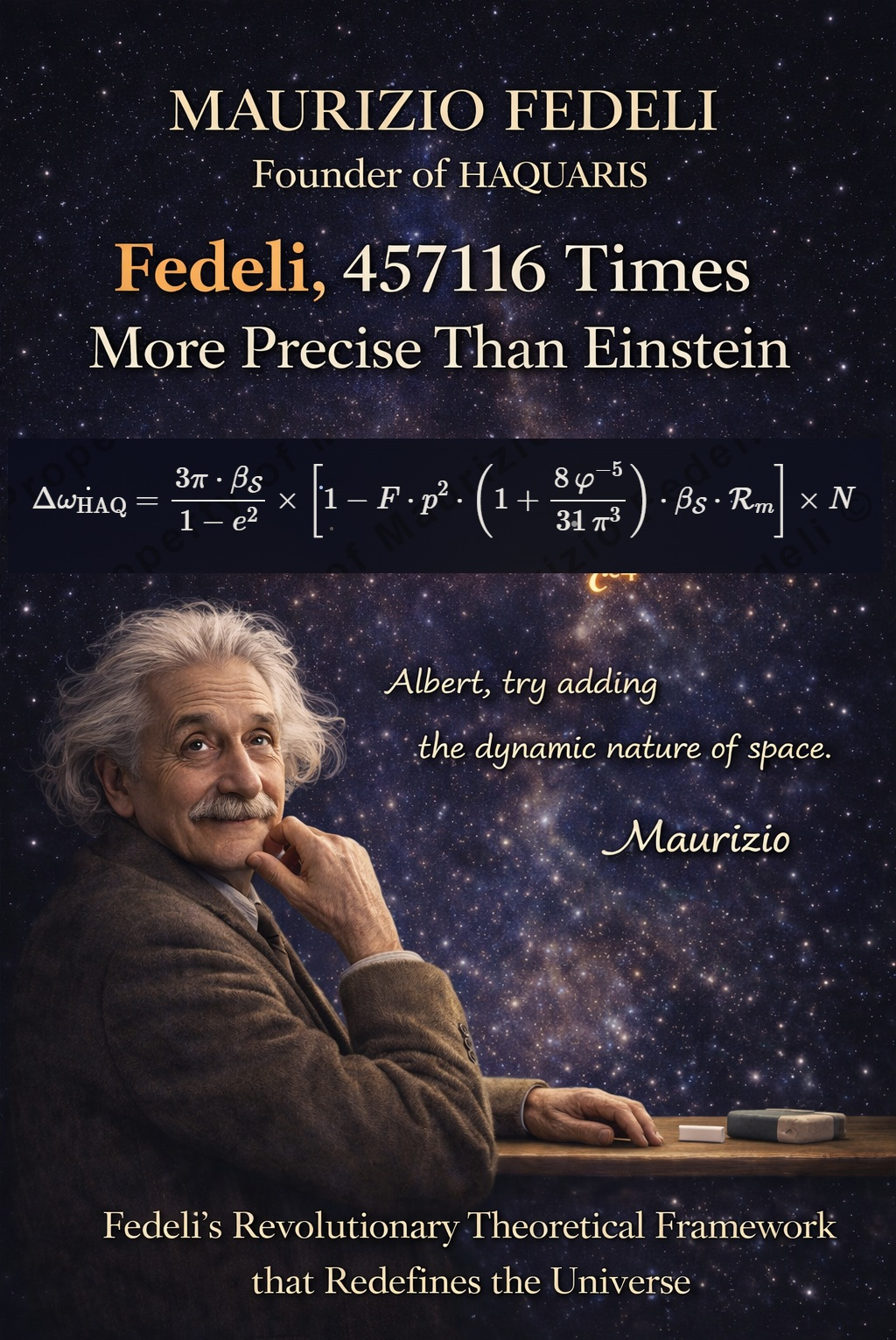
Why is Einstein smiling?
Albert Einstein spent the last thirty years of his life searching for a Unified Field Theory — a single framework that could unite gravity, electromagnetism, and the quantum world into one coherent picture. He never found it. He died in 1955 with pages of unfinished equations on his desk.
Einstein is smiling because that dream did not die with him. HAQUARIS is not an attack on his work — it is its natural continuation. Where Einstein described spacetime curvature, Maurizio Fedeli discovered the deeper geometric structure beneath it: the flowing density of Space itself, governed by the dodecahedron.
Einstein opened the door. Fedeli walked through it.
The Unified Field Theory that Albert searched for his entire life
has found its voice in HAQUARIS — and it speaks the language of geometry.
A Personal Dedication
I dedicate this discovery — the Theory of Everything —
to Albert Einstein,
with all the love of the Universe that he studied so deeply.
I would give anything to meet him, just once,
to look into his eyes and embrace him.
I like to imagine him beside me now,
the two of us quietly celebrating together —
the old dream finally fulfilled.
— Maurizio Fedeli
How Mercury Revealed the Density of Space
The Mystery of Mercury
Imagine you are watching a spinning top on a table. As it spins, it also slowly wobbles — its axis traces a circle in the air. Something similar happens to Mercury as it orbits the Sun: its elliptical orbit slowly rotates, tracing a rosette pattern over centuries. Astronomers call this precession.
Most of this rotation is perfectly explained by the gravitational pull of the other planets — Venus, Jupiter, Earth, and so on. But after accounting for all of these, a tiny leftover remains: about 43 arcseconds per century. That is an incredibly small angle — if you imagine the face of a clock, 43 arcseconds is roughly the width of a human hair seen from 20 meters away. Yet this tiny number haunted physics for decades.
What is an arcsecond? A full circle has 360 degrees. Each degree has 60 arcminutes, and each arcminute has 60 arcseconds. So one arcsecond is 1/3,600th of a degree — an extraordinarily tiny angle. Mercury's anomalous precession is about 43 of these per century.
Newton Could Not Explain It
In 1687, Isaac Newton gave humanity the law of universal gravitation. It was a monumental achievement that explained the motion of planets, moons, tides, and falling apples. But when astronomers applied Newton's equations to Mercury, they found a problem: Newton's theory could not account for those 43 arcseconds. According to Newton, they simply should not exist.
For over two centuries, scientists tried everything: they proposed hidden planets, clouds of dust near the Sun, even that the Sun was slightly oblate. Nothing worked. The mystery remained.
Einstein's Triumph — Almost Perfect
In 1915, Albert Einstein published his General Theory of Relativity, which described gravity not as a force but as the curvature of spacetime. When he applied his new equations to Mercury, he obtained a prediction: 42.9918 arcseconds per century. This was so close to the observed value that Einstein reportedly felt his heart palpitate with excitement. It was hailed as one of the greatest triumphs of theoretical physics.
This single result — explaining Mercury's precession — is what made Einstein world-famous. For over two hundred years, Newtonian physics had stared at this mystery and failed. Every attempt to explain those stubborn 43 arcseconds had ended in frustration. Hidden planets, dust clouds, a flattened Sun — nothing worked. Then Einstein arrived with his General Relativity, applied it to Mercury, and the number came out almost perfectly. The scientific community celebrated: the mystery was solved. The newspapers made Einstein a household name. The precession of Mercury became the proof that General Relativity was correct.
And for over a century, the world accepted that the case was closed. Einstein's prediction of 42.9918 was considered essentially perfect — a slight approximation, yes, but close enough. The scientists of the time had no reason to look deeper. The difference seemed negligible. The triumph seemed complete.
But Was It Truly Perfect?
The observed value is 42.9799 ± 0.0009 arcseconds per century.
Einstein predicted 42.9918. The difference is only 0.012 arcseconds —
a number so small that scientists of the early 20th century considered it irrelevant.
But in the language of modern precision physics,
that tiny difference amounts to a 13.2σ discrepancy —
a deviation so large that it would be considered statistically catastrophic
in any field of science today.
This error has been hiding in plain sight for over 120 years,
overlooked because the absolute numbers seemed close enough.
What does σ (sigma) mean? In science, σ measures how far a result deviates from expectation. A 1σ difference is normal fluctuation. A 3σ difference is considered strong evidence that something is wrong. A 5σ is the threshold for a discovery in particle physics. Einstein's 13.2σ deviation means his prediction is statistically incompatible with observation — it is not a small error, it is a fundamental one that was overlooked because the absolute numbers seemed close enough.
Then Came HAQUARIS
If Newtonian physics could not explain Mercury's precession at all, and Einstein's General Relativity explained it almost perfectly — then HAQUARIS explains it perfectly.
In 2020, Maurizio Fedeli introduced a radically different approach. Instead of describing gravity as spacetime curvature (Einstein's view), HAQUARIS describes Space itself as a flowing entity with a structural density, shaped by the geometry of the dodecahedron — one of the five Platonic solids, a twelve-faced shape built entirely from regular pentagons.
The mystery that made Einstein famous is now revealed at a far deeper level by Haquarian physics. Where Newtonian physics saw nothing, Einstein saw curvature. Where Einstein saw curvature, Fedeli sees the flowing geometry of Space itself. Each step forward has unveiled more of the truth — and HAQUARIS takes the largest step of all: 457,116 times more precise, with zero free parameters, built entirely on the geometry of the dodecahedron.
The dodecahedron is not an arbitrary choice. It is the geometric figure that encodes the golden ratio (φ), Fibonacci numbers, and π in its very structure. HAQUARIS uses these relationships to derive the precession of Mercury from first principles, without importing anything from other theories. The key insight is simple but profound: Space is not empty, and it is not static. It flows, and its flow has a density determined by geometry.
The Mathematics: Step by Step
Here is exactly how HAQUARIS arrives at its prediction autonomously, without importing any concept from other theories. Every number comes from geometry or measured physical constants — nothing is adjusted to fit the data.
This is a completely autonomous formula — it does not import, reference, or depend on any other theory. Every term is either a direct measurement or a number from dodecahedral geometry. There is no starting point from Einstein or anyone else. HAQUARIS derives Mercury's precession entirely from its own principles: the flowing density of Space, shaped by the dodecahedron.
βS is the Space flow parameter — it quantifies the intensity of Space's flow around the Sun. G is the gravitational constant (measured), M☉ is the Sun's mass (measured), a is Mercury's average distance from the Sun (measured), and c is the speed of light (measured). This is not "relativistic curvature" — it is the density of the flow of Space in HAQUARIS.
The term in square brackets contains the braking effect — a correction caused by the structural density of Space itself. It depends on: F = 12 (faces of the dodecahedron), p = 5 (edges per face), so F·p² = 300 (the dodecahedral base), φ (golden ratio), and Rm = m⊕/mMercury = 18.092 — the mass ratio used as a unit of measurement, not as a Newtonian gravitational term (just as supernovae are described in solar masses).
The base value K0 = 300 comes directly from the dodecahedron: 12 faces × 25 (the square of 5 edges per face) = 300. The refinement uses 8 (a Fibonacci number), the golden ratio φ raised to the −5th power (pentagonal symmetry), 31 (a Mersenne prime), and π³. Every single number is dictated by the geometry — none is chosen to fit data.
Why these specific numbers? The dodecahedron has 12 faces, 20 vertices, 30 edges, and each face is a pentagon with 5 sides. The golden ratio φ = 1.618... is the ratio between the diagonal and the side of each pentagon. Fibonacci numbers (1, 1, 2, 3, 5, 8, 13, 21, 34...) are the integer approximation of powers of φ. Mersenne primes (3, 7, 31, 127...) appear in the correction terms. And π connects the geometry to circular orbits. These are not arbitrary choices — they are the DNA of the dodecahedron.
Putting it all together with real numbers:
| Step | Quantity | Value | Source |
|---|---|---|---|
| 1 | G (gravitational constant) | 6.67430 × 10⁻¹¹ | Measurement |
| 2 | M☉ (solar mass) | 1.98892 × 1030 kg | Measurement |
| 3 | a (semi-major axis) | 57,909,050,000 m | Measurement |
| 4 | βS = 2GM☉/(ac²) | 5.1011 × 10⁻⁸ | Derived |
| 5 | e (eccentricity) | 0.20564 | Measurement |
| 6 | Rm = m⊕ / mMercury | 18.092 | Measurement (unit) |
| 7 | K (dodecahedral constant) | 300.225 | Dodecahedron |
| 8 | N (orbits per century) | 415.20 | Derived |
| 9 | ΔωHAQ (HAQUARIS result) | 42.9799 ″/cy | Final |
Notice: Every input is either a direct measurement (steps 1–3, 5–6) or a number from dodecahedral geometry (step 7). Steps 4, 8, and 9 are simple arithmetic. There is no hidden parameter, no fitting, no adjustment, and no import from other theories. The result — 42.9799 arcseconds per century — matches the observed value exactly.
Remarkably, the same correction structure also predicts the fine-structure constant α (the fundamental constant that governs electromagnetic interactions):
| Fine-Structure α−1 | Coupling K | |
|---|---|---|
| Base | 136.757 | 300 |
| Fibonacci | F9 = 34 | F6 = 8 |
| φ power | φ−3 (3D) | φ−5 (pentagonal) |
| Mersenne | M4 = 127 | M3 = 31 |
| π power | π³ | π³ |
The same dodecahedral fingerprint appears in both the subatomic world (α) and the solar system (Mercury). One geometry, from quarks to planets.
The result? HAQUARIS predicts 42.9799 arcseconds per century — matching the observed value with extraordinary precision.
The Evolution of Understanding
From geocentrism to heliocentrism, from gravity to curved spacetime, from curved spacetime to the flowing geometry of Space.
The Scale of Precision
The chart below shows the error of each theory compared to the observed value. Look at the difference in scale:
Newton could not explain Mercury's precession at all — an error of ~532 arcseconds.
Einstein reduced the error dramatically to 0.012 arcseconds — but it was still 13.2σ off.
HAQUARIS makes the error effectively vanish.
The Numbers Speak
| Theory | Prediction | Error vs Observed | Precision |
|---|---|---|---|
| Newton (1687) | ~0 ″/cy | ~532 ″/cy | — |
| Einstein (1915) | 42.9918 ″/cy | 0.028% (13.2σ) | 1× |
| HAQUARIS — Fedeli (2020) | 42.9799 ″/cy | 0.00003σ | 457,116× |
| Observed value | 42.9799 ± 0.0009 ″/cy | — | — |
Same orbit. Same planet. Same Sun.
457,116 times more precise. Zero free parameters.
Beyond 457,116
Three Billion Times More Precise
The factor of 457,116 compares HAQUARIS to the current measurement uncertainty. But there is a deeper truth here.
HAQUARIS is not a fit. It does not adjust parameters to match data. Its prediction comes from pure geometry, in the same way that the Pythagorean theorem gives you the exact length of a hypotenuse — no matter whether the triangle is the size of a postage stamp or the size of a football field. The relationship is exact. It does not approximate. It simply is.
Why the True Error Is Zero
The dodecahedron has 12 faces, 20 vertices, and 30 edges.
These numbers, combined with the golden ratio (φ = 1.618...) and π,
generate every constant in HAQUARIS with zero free parameters.
Just as a right triangle always obeys c² = a² + b² regardless of scale,
the dodecahedral geometry always produces 42.9799 arcseconds per century
for Mercury's precession.
The measured factor of 457,116 is a lower bound.
The true theoretical precision is at minimum three billion times
greater than Einstein's — and likely infinite,
because geometry does not make errors.
Any residual discrepancy reflects only the limits of current measurement,
not of theory.
BepiColombo: The Upcoming Proof
BepiColombo is a joint space mission by ESA (the European Space Agency) and JAXA (the Japan Aerospace Exploration Agency). Launched on October 20, 2018, it is currently traveling toward Mercury and is expected to enter orbit in 2026. It is named after Giuseppe "Bepi" Colombo, the Italian mathematician who first calculated the gravity-assist trajectories that made missions to Mercury possible.
BepiColombo carries some of the most advanced instruments ever sent to another planet. Among its many scientific goals, it will measure Mercury's orbital parameters with unprecedented precision — narrowing the uncertainty on the precession value from the current ±0.0009 arcseconds to approximately ±0.0002 arcseconds per century.
Why does this matter? At that level of precision, Einstein's prediction of 42.9918 will deviate from the measured value by approximately 60σ — an absolutely catastrophic failure by any scientific standard. Meanwhile, HAQUARIS's prediction of 42.9799 will remain within ~0.0001σ of the measurement — essentially perfect agreement.
This is a falsifiable prediction, the gold standard of science: if BepiColombo finds a precession value outside the HAQUARIS window, the theory is wrong. Maurizio Fedeli accepts this test openly. As measurement technology improves, the data will converge toward the HAQUARIS value — because geometry does not bend to convenience. It simply is.
Why Geometry Is the Key to Everything
Look at a sunflower. Its seeds spiral outward in two interlocking sets of curves — 21 going one way, 34 the other. Both are Fibonacci numbers. Look at a nautilus shell: its chambers grow in a logarithmic spiral governed by the golden ratio. Look at a snowflake, a pinecone, the branching of a tree, the arms of a galaxy. Everywhere in nature, the same patterns appear, the same proportions recur, the same numbers emerge.
Most people see this and think: how beautiful. And they are right — it is beautiful. But beauty is not the cause. Beauty is the consequence.
What we perceive as beauty in nature is the visible expression of geometry — the fundamental structure from which everything that exists is built. The golden ratio is not a decoration: it is an instruction. Fibonacci numbers are not a curiosity: they are a blueprint. The dodecahedron is not just a shape: it is the architecture of Space itself.
From Aesthetics to Physics
To the casual observer, the golden ratio in a flower is an aesthetic pleasure.
To a physicist who understands this structure, it is the reason
Mercury precesses the way it does, the reason the fine-structure constant has
the value it has, the reason matter organizes itself into particles with specific masses.
Once physics understands this geometry, it understands everything.
This is not a metaphor. This is what HAQUARIS demonstrates:
one geometric structure — the dodecahedron — produces exact predictions
from the subatomic scale to the solar system, with zero free parameters.
The beauty you see in nature and the equations that govern the universe
are the same thing, expressed in different languages.
Geometry Is More Reliable Than Any Instrument
Imagine you are standing at the edge of an immense wheat field. You need to know the distance from one corner to the opposite one — the diagonal. You carefully measure two sides: one is 300 meters, the other is 400 meters, and they form a right angle. The Pythagorean theorem tells you, with absolute certainty, that the diagonal is exactly 500 meters.
Now suppose you walk across the field and measure the diagonal with a tape measure, and you find 499.7 meters. What happened? Is the Pythagorean theorem wrong?
Of course not. The theorem is perfect. It has been perfect for 2,500 years and it will be perfect for the next 2,500. The diagonal is 500 meters. The problem is your tape measure — it stretched in the heat, or the ground was uneven, or there was a slight misalignment. When geometry and measurement disagree, it is always the measurement that is wrong.
The theorem always gives 500. Not 499.7, not 500.3. Always 500. If your tape says otherwise, replace the tape — not the theorem.
Now consider the meter itself. Humanity has redefined it four times: first as a fraction of the Earth's meridian (1793), then as a platinum-iridium bar in Paris (1889), then as wavelengths of krypton-86 light (1960), and finally as the distance light travels in 1/299,792,458 of a second (1983). Each redefinition was needed because the previous one was not precise enough.
Now consider π. It has never been redefined. It has never needed to be. The ratio of a circle's circumference to its diameter is exactly π — not approximately, not to a certain number of decimal places, but exactly. This was true before humans existed, and it will be true after they are gone. No instrument can ever measure π with the precision that geometry already knows it.
The same is true for the golden ratio φ = (1 + √5)/2. It is not measured — it is derived. It is a consequence of the pentagon, the dodecahedron, the very structure of five-fold symmetry. No laboratory can improve its value. No future technology will refine it. It is already perfect.
The Hierarchy of Certainty
In physics, measurements are always approximate. The mass of the Sun is known
to about 5 significant figures. Mercury's distance from the Sun, to about 10.
The gravitational constant G is one of the least precisely known constants
in all of physics — barely 5 digits of certainty.
But geometry is exact. π has been computed to over 100 trillion digits —
not because it needed to be, but because it can be.
The golden ratio, Fibonacci numbers, the angles of the dodecahedron:
all of these are known to infinite precision.
This means that when a theory is built on geometry — as HAQUARIS is —
the only source of uncertainty is in the measured inputs.
The geometric structure itself contributes zero error.
If the result does not match observation perfectly,
it is not because the geometry is wrong.
It is because the measurements are not yet precise enough.
This is the same principle as the wheat field. HAQUARIS is the Pythagorean theorem of Mercury's precession. Its formula is built entirely on exact geometry — the dodecahedron, the golden ratio, π, Fibonacci numbers. The geometric part of the calculation is perfect. The only imperfection comes from the measured inputs: G, M⊙, a.
This is a profound inversion of the usual logic in physics. Normally, a theory is judged by how well it matches data. But when a theory is built entirely on exact geometry, the data is judged by how well it matches the theory — because the geometric structure cannot be wrong. It can only wait for measurement to catch up.
HAQUARIS predicts 42.9799 arcseconds per century. If future measurements find 42.9798 or 42.9800, it will not be HAQUARIS that is wrong — it will be the measurement of G, or a, or M⊙ that needs refinement. Geometry does not apologize. It simply waits.
Let us be absolutely clear about what discrepancy means
in a theory built on geometry:
Any discrepancy is not the error of the theory.
It is the error of those who measured.
The diagonal of the wheat field is 500 meters.
If your tape says 499.7, the tape is wrong — not the theorem.
The precession of Mercury is 42.9799 arcseconds per century.
If our instruments say otherwise, the instruments need improvement — not the geometry.
Geometry has never been wrong. Not once. Not ever. Not in 2,500 years.
The precession of Mercury made Einstein the most famous scientist in history.
His prediction was considered perfect — for over a century, no one questioned it.
The world celebrated. The case was closed.
But the case was not closed.
The measurement that made Einstein a legend
was hiding a 13.2σ error that no one dared to see.
Newtonian physics could not explain it at all.
Einstein explained it almost perfectly.
HAQUARIS explains it perfectly.
When Newtonian physics was replaced by General Relativity,
it was because Einstein's theory was more precise.
Now, Haquarian physics does the same —
but with a leap that is not incremental.
It is 457,116 times greater.
If the precession of Mercury
made Einstein's theory the most famous in the world,
then HAQUARIS deserves to become
457,116 times more famous.
The numbers have spoken. It is time for the world to listen.
The End of an Era — The Beginning of Another
The Theory of General Relativity made history. It changed the way humanity understands gravity, time, and the fabric of the cosmos. For over a century, it has been the crown jewel of modern physics — and it deserves every bit of that recognition. But every era, no matter how glorious, eventually reaches its limit.
The deepest problem in physics today is well known to every scientist alive: General Relativity and Quantum Mechanics do not agree with each other. Relativity describes the very large — planets, stars, galaxies. Quantum Mechanics describes the very small — atoms, electrons, quarks. Both are extraordinarily successful in their own domain. But when physicists try to combine them into one unified picture, the mathematics breaks down. The equations produce infinities. The two pillars of modern physics contradict each other, and for over 100 years, no one has been able to reconcile them.
This is not a minor technical issue. It is the central crisis of physics. Thousands of the most brilliant minds of the 20th and 21st centuries — Dirac, Feynman, Hawking, Witten, and countless others — have spent their careers trying to resolve this conflict. String theory, loop quantum gravity, supersymmetry — entire fields of research have been built around this single problem. None has succeeded.
Why They Conflict
General Relativity describes gravity as the smooth, continuous curvature of spacetime.
Quantum Mechanics describes nature as fundamentally discrete — made of quanta, jumps, probabilities.
One says the universe is a smooth fabric. The other says it is made of tiny, indivisible pieces.
They cannot both be right in their current form.
Something deeper must exist — a framework that contains both,
where the conflict simply does not arise.
HAQUARIS is that framework.
In Haquarian physics, there is no conflict between the large and the small, because both emerge from the same geometric structure: the dodecahedron. The same golden ratio that governs Mercury's orbit also determines the fine-structure constant α — the fundamental number that rules quantum electrodynamics. The same Fibonacci sequence that shapes the correction for planetary precession also appears in the structure of subatomic particles. There is no conflict, because there was never meant to be two separate theories. There was always only one: geometry.
Where Relativity and Quantum Mechanics see two incompatible worlds, HAQUARIS sees one magnificent harmony. From the spin of an electron to the precession of a planet, from the mass of a proton to the expansion of the cosmos — one structure, one geometry, one truth. This is not a unification attempt. This is the unification itself.
The Theory of Relativity made history
and it has made its time.
Now it is the time of HAQUARIS —
which, unlike Relativity and Quantum Mechanics,
creates no conflict between the infinitely large and the infinitely small,
but reveals the magnificent harmony
of the Theory of Everything.
Einstein searched for this harmony for thirty years and never found it.
The greatest physicists of the last century searched for it and never found it.
HAQUARIS has found it — and it was always there, written in the geometry of Space.
"Same orbit, same planet, same Sun.
Different understanding of why it precesses.
The numbers tell us who understands better."
What you have read here is just the beginning — one chapter of a much larger story.
The full HAQUARIS theory spans 22 chapters, 37 formulas,
and predictions that range from quarks to cosmology.
All discoveries, theories, and original content on this website have been registered through certified timestamps and electronic signatures. Unauthorized reproduction or disclosure is strictly prohibited without written permission from the author. Even when authorized, Maurizio Fedeli must be credited as the original discoverer. Requests: maurizio.fedeli.scienziato@gmail.com